
Inspired Team
In early 2020, we sat down with Michael Brown, Alex Eu, and Kevin Shiiba — the three co-founders of Teamshares. They were running a five-person team out of a WeWork, had just closed their first acquisition, and had two more businesses under a letter of intent. What they described to us that day was not a pitch in the traditional sense. It was closer to a conviction: that the American small business economy was facing a quiet crisis, that the people most loyal to those businesses deserved to own them, and that a company built around solving both of those things at once could be something genuinely lasting.
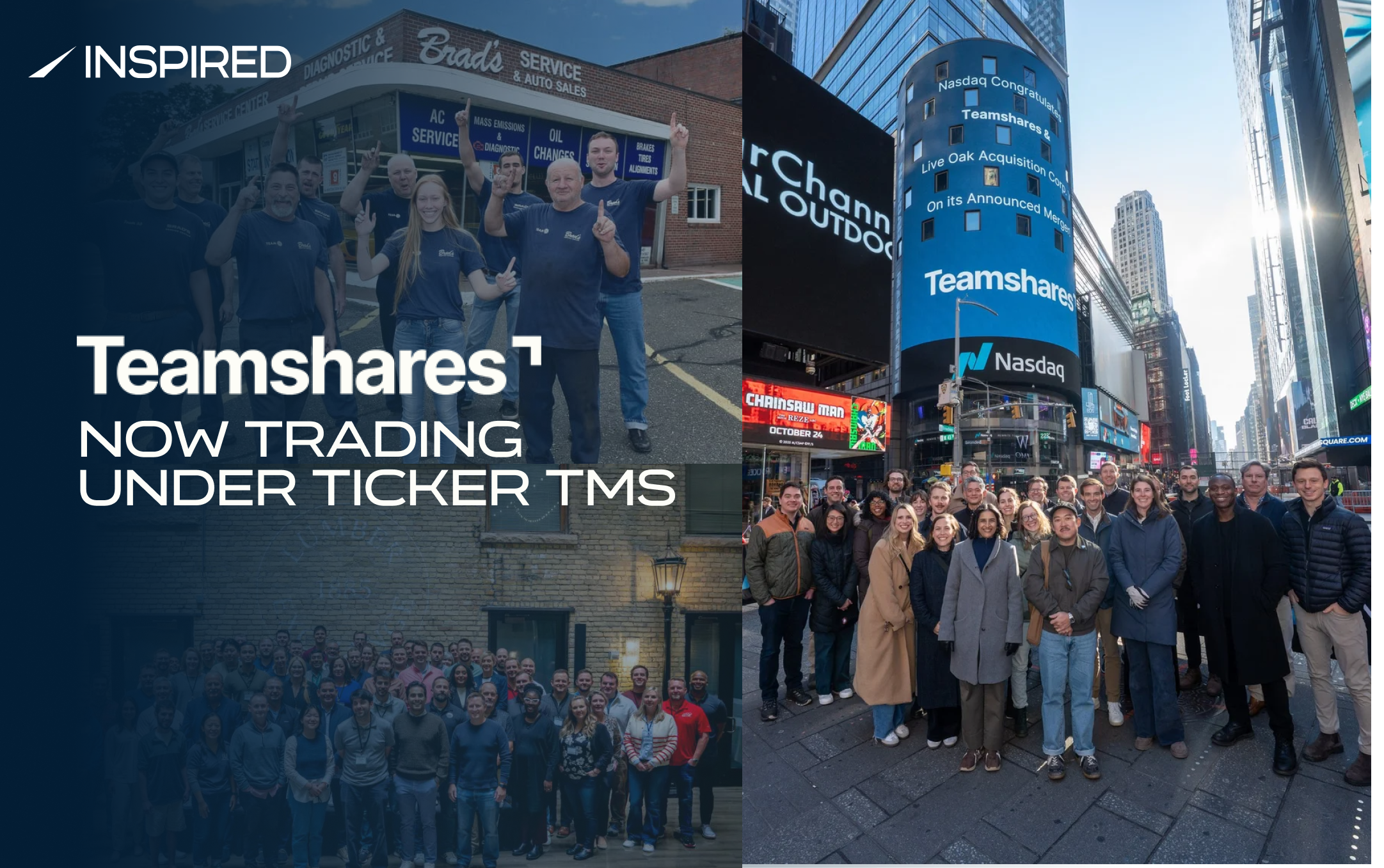
We have been proud to back Teamshares since 2020, wiring our investment right before COVID hit. Today, Teamshares begins trading on Nasdaq under the ticker TMS. Reflecting on that first meeting, we are struck by how much they said they would build — and did — and how much they will continue to do so in the public markets.
Three Founders Who Had Already Lived the Problem
What made Michael, Alex, and Kevin different from the other founders we met in this space was that they had not theorized their way into the opportunity. They had operated their way into it.
All three met in investment banking, spending years advising large companies on acquisitions from a safe professional distance. Michael was the first to cross that distance. He left New York to purchase a small electrical contractor in Western Canada and moved there to run it himself. "I left New York for two years to figure out how to run the business," he has said. What he found was that the gap between modeling a business on a spreadsheet and actually running one was enormous, and that gap would become the foundation of everything Teamshares later built. Alex eventually joined him to buy the second business, and Kevin came in as a technology advisor. By the time the three of them had acquired eight small businesses together, they had shifted entirely from financial professionals into genuine operators.
The insight that would become Teamshares emerged from inside that experience. One of their largest customers was a fully employee-owned general contractor generating billions in annual revenue, a company that had been purchased from its founding family just a generation earlier for around $40 million. The wealth that transition had created for the workers inside that business was remarkable, and it was repeatable, and it planted a question that the three of them could not stop asking.
At the same time, as they moved through more acquisitions, they kept watching the same painful dynamic play out on the seller's side: retiring owners with no one to hand their life's work to. According to the Exit Planning Institute, 70% of small businesses listed for sale in the U.S. never find a buyer. When that happens, businesses that have quietly served communities for decades simply disappear, and the people who built them have nothing to show for it.
In 2019, Michael, Alex, and Kevin founded Teamshares to be exactly that: a buyer for businesses looking for their next owners, and a path to ownership for the employees who had helped build them
What We Saw When We Met Them
Our investment memo described Teamshares as "creating employee ownership for small businesses," a deceptively simple phrase for what was actually a full-stack platform in the making. The model at the time was to buy companies from retiring owners, retain key employees with a stock pool, and gradually convert each business toward employee ownership through stock buybacks over 10 to 20 years. Layered on top was a digital product roadmap that covered everything from automated sourcing and digital underwriting to equity management, financial monitoring, and ongoing financial education for employee owners across the network. In our memo, we compared what they were building to "a blend of Opendoor, Divvy, and Yieldstreet," making acquisitions faster and simpler, enabling ownership to transfer over time, and opening up an entirely new asset class for widespread investment. In many ways, they were building the Carta for the old economy, digitizing an asset class that had stayed entirely analog.
What really stuck out to us was the broader observation we wrote down about economic geography. The businesses Teamshares was going after were concentrated in communities where economic opportunity is less abundant than in New York or San Francisco, where employee ownership could do the most transformative work. We drew an analogy to how AirBnB unlocked economic opportunity for homeowners and ride-sharing did the same for car owners: new incentive structures, applied to people who already had the underlying asset, could unlock productivity and wealth that had never existed before. That framing convinced us that the social mission and the business model were not in tension with each other. They were the same thing.
What They Said, and What They Actually Built
The vision Michael articulated from day one was not a five-year plan but a 200-year plan. He traced the 200-year thinking back to his 30th birthday in Hong Kong, where he was struck by companies like Jardine Matheson and Swire, trading operations that had started small two centuries earlier and grown into generational institutions. "That was just very inspiring, that a few people trading goods could create such an incredible business over time. It really shaped how we think about building a durable business for the long term." He talked about wanting Teamshares to be "the Arthur Rock of small business," the force that makes employee ownership the default across an entire sector the way Rock's early championing of stock options changed the culture of Silicon Valley. And he made a promise that has guided every acquisition since: the businesses Teamshares buys would never be for sale again.
From the time we invested when they were at less than $2m in revenue to today, the team has delivered on that vision at a scale that would have seemed ambitious to say out loud in that WeWork. Teamshares has now acquired 92 companies across 30+ states and 40+ industries, generating ~$500 million in consolidated revenue and $60 million in operating EBITDA. They built a top-end product and engineering team to power the platform behind every acquisition. Employee owners across the network have been receiving real stock and real dividends in the businesses they show up to every day. None of this came easily. "We've gone through many ups and downs with the company, but the company's ambition has never changed."
Why Going Public Changes Everything (and Why It's Still the First Inning)
For most companies, going public is primarily a liquidity event. For Teamshares, it is something more structural than that. The core of the model is an acquisition engine, and that engine runs on capital, specifically the debt capital used to fund each purchase. As a private company, assembling a new debt facility can take quarters and comes with significant constraints, a meaningful challenge for a business trying to buy dozens of companies a year. As a public company, that same process can happen much faster and at a fraction of the cost, with the additional option of using equity to fund acquisitions directly. As Michael put it when we sat down with him earlier this year: "There's two dynamics that happen for Teamshares when we go public. One is the availability of a lower cost of debt. And on the equity side, we also now have stock that we can pay for businesses with. So it gives us a really nice set of tools." For a business whose entire growth engine depends on acquiring one more company, and then one more after that, the difference between those two capital structures is not marginal. It is everything.
The pipeline those tools will unlock is not theoretical. Since launching their sourcing software in early 2020, 475,000 businesses have come through it, all actively for sale, all size-qualified. Nearly 90% of U.S. small businesses are owned by Boomers and Gen X, and 6 million will change hands by 2035. The opportunity has never been the constraint. Having the right capital structure to pursue it at speed is what changes today.
Teamshares is going public via a business combination with Live Oak Acquisition Corp. V, anchored by a $126 million PIPE led by T. Rowe Price Investment Management, and trading on Nasdaq under the tickers TMS. We have been proud to serve as the longest-standing institutional board member other than the founders and our belief in this team is as strong as it has ever been.
When Alexa sat down with Michael earlier this year, he said he “does not know whether Teamshares is in the top or the bottom of the first inning, but that either way, it is still the first.” Having watched this team build steadily through conditions that would have stopped most companies, we believe every word of it.
Congrats to Michael, Alex, Kevin, and the entire Teamshares team on going public! We have been proud to be your partners since the very beginning, and are excited for your first inning.